
The Act Matrix: A Simple Tool for Getting Unstuck
What is it?
Have you ever known exactly what matters to you…and still found yourself doing the opposite? Maybe connection matters to you, but when you feel hurt, you withdraw. Maybe you want to take better care of yourself, but anxiety keeps telling you to wait until you feel more confident. Maybe you value being present with your family, but when you're overwhelmed, you become irritable, shut down, or disappear into your phone. Or maybe you've spent so much time trying to get rid of anxiety, self-doubt, guilt, or uncomfortable thoughts that your life has slowly started revolving around not feeling bad, rather than moving toward what actually matters to you. This is exactly the kind of pattern the ACT Matrix can help us understand.
The ACT Matrix is a tool used within Acceptance and Commitment Therapy (ACT) to build psychological flexibility, the ability to stay in contact with what we're experiencing while choosing actions that reflect what matters to us. Importantly, the goal isn't to eliminate uncomfortable thoughts and feelings. It's to have more choice about what we do when they show up.
The Two Questions at the Heart of the ACT Matrix
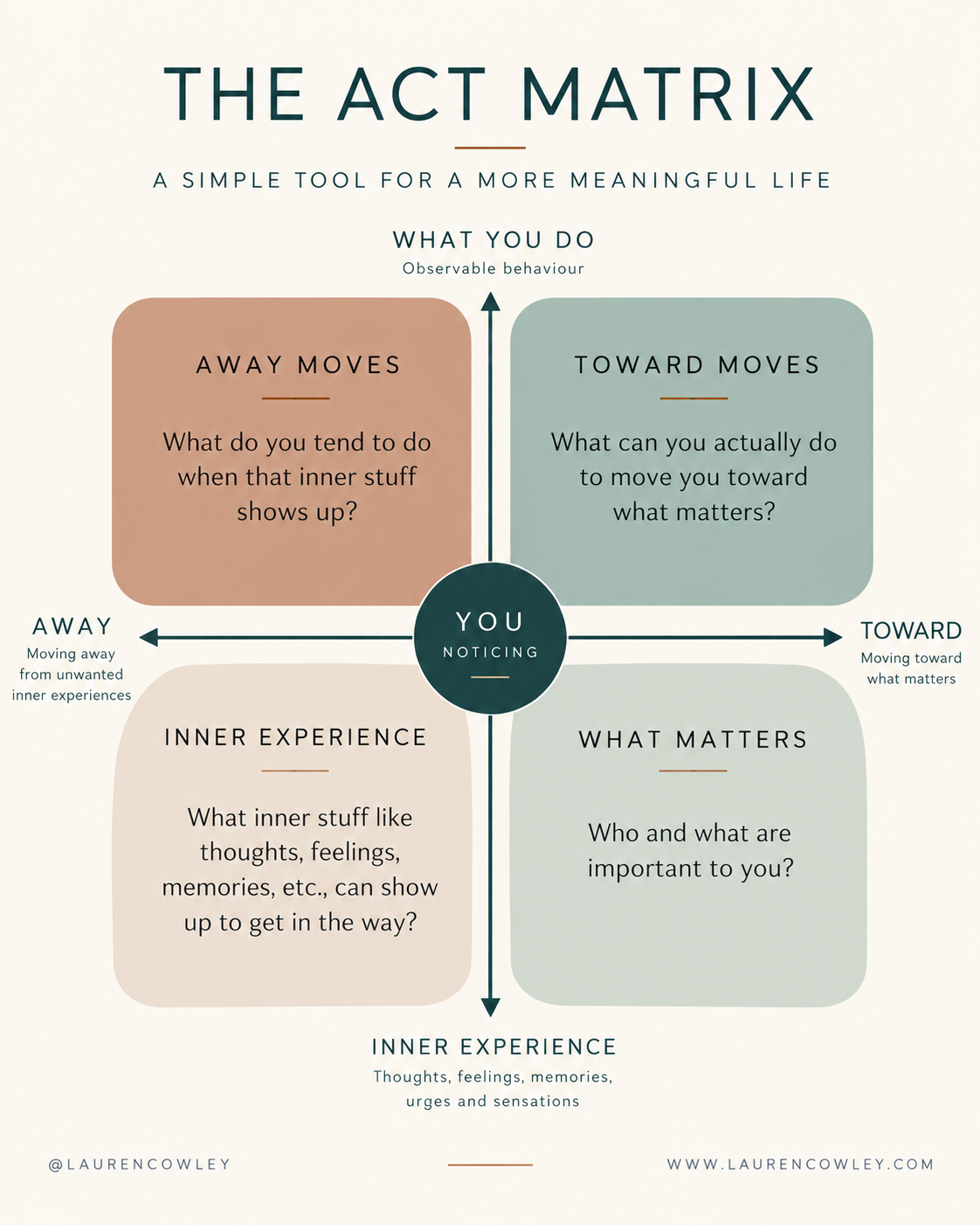
The Matrix is divided into four quadrants, but it really helps us make two important distinctions:
What's happening inside of me (thoughts, feelings, sensations), and what am I actually doing (behaviour)?
and
Am I moving toward something that matters, or am I trying to move away from something uncomfortable inside of me?
Those two distinctions create the four areas of the Matrix.
Let's walk through them.
1. Who and What Matters to Me?
We usually begin in the bottom-right quadrant by identifying our values. Values aren't goals to check off a list. They're qualities and directions that help describe how we want to live and who we want to be.
You might ask yourself:
Who matters to me?
What kind of person do I want to be?
What do I want my relationships to feel like?
How do I want to treat myself?
What do I want my life to stand for?
Your answers might include things like connection, curiosity, family, honesty, compassion, courage, adventure, creativity, health, playfulness, or growth. You might want to be a present parent, a compassionate partner, a reliable friend, or someone who approaches life with curiosity. There isn't a "correct" set of values. The important question is: What actually matters to you?
2. What Shows Up Inside of Me?
Once we know what matters, we can start noticing what shows up internally that makes moving toward those things difficult. This is the bottom-left quadrant of the Matrix.
It can include thoughts that are uncomfortable like:
"I'm not good enough."
"What if I fail?"
"They're going to judge me."
"I should be able to handle this."
It can also include emotions and physical experiences such as anxiety, shame, sadness, anger, loneliness, tension, uncertainty, vulnerability, or fear. Memories and urges can live here too.
ACT refers to these as private or internal experiences. And here's where ACT is a little different from approaches that focus primarily on changing the content of our thoughts. We don't necessarily need to decide whether every thought is true or false.
We can simply notice:
"This is what's showing up for me right now."
Because uncomfortable internal experiences aren't necessarily obstacles that have to be removed before we can live our lives. Sometimes they're simply passengers coming along for the ride.
3. What Do I Do to Get Away From Discomfort?
Now we move above the horizontal line of the Matrix, into things we can actually do. The top-left quadrant contains what ACT calls away moves: behaviours that function to move us away from unwanted thoughts, emotions, memories, urges, or physical sensations.
That might look like:
Procrastinating.
Avoiding a conversation.
Seeking reassurance.
People-pleasing.
Overthinking.
Withdrawing.
Scrolling for hours.
Overworking.
Keeping constantly busy.
Cancelling plans.
Using food, substances, shopping, or other behaviours to escape how we're feeling.
An important part of ACT is that we don't need to judge these behaviours. There is usually a reason we developed them. If avoiding something reduces your anxiety, even temporarily, of course your brain is going to suggest doing it again. If reassurance makes uncertainty disappear for five minutes, it makes sense that you'll want more reassurance the next time uncertainty appears. So in fact, away moves often work beautifully in the short term.
BUT. the more useful question is:
How is this working for me over time?
If avoiding difficult conversations protects you from discomfort today but gradually creates distance in your relationship, that's useful information. If procrastination provides immediate relief but creates greater anxiety tomorrow, that's useful information too. We're not asking whether the behaviour is "good" or "bad." We're noticing what it does.
4. What Moves Me Toward What Matters?
The top-right quadrant contains our toward moves: observable actions that bring us closer to the people, qualities, and values we identified earlier. If you value connection, a toward move might be sending the text you've been avoiding. If you value being a present parent, it might be putting your phone down and spending ten intentional minutes with your child. If you value honesty, it might be saying what you're actually feeling. If you value self-respect, it might be setting a boundary. If you value health, it might be taking a ten-minute walk. If you value friendship, it might be accepting an invitation even though your anxious mind is giving you twenty reasons to stay home.
Toward moves don't need to be dramatic. In fact, some of the most meaningful ones are incredibly small.
The question now becomes:
"What is one thing I could do right now that moves me a little closer to the person I want to be?"
The Goal of ACT Isn't to Get Rid of Difficult Thoughts and Feelings
This is one of the most important parts of the ACT Matrix. The goal is not to eliminate the bottom-left quadrant. You aren't failing at ACT because you still experience anxiety, sadness, shame, insecurity, intrusive thoughts, or painful memories. And the goal isn't to eliminate every away move either. We're human. Sometimes we avoid things. Sometimes we distract ourselves. Sometimes watching Netflix instead of confronting our existential crisis is exactly what we're going to do that evening. The Matrix is about awareness and flexibility, not perfection. We want to become better at noticing when we're operating automatically so that, when it matters, we have the ability to choose something different.
"But I Don't Feel Ready Yet"
This is where ACT can be particularly powerful. We often unknowingly create rules for ourselves that say:
"I'll do it when I'm less anxious."
"I'll have the conversation when I'm more confident."
"I'll start dating when I feel better about myself."
"I'll set the boundary when I'm not so afraid of disappointing them."
"I'll enjoy my life once everything settles down."
The problem is that our internal experience doesn't always cooperate. ACT offers a different question:
"What if I don't have to wait for this feeling to disappear?"
You can feel anxious and take the step.
You can experience self-doubt and speak up.
You can feel guilty and maintain the boundary.
You can feel afraid and move toward connection.
Acceptance doesn't mean liking the feeling or resigning yourself to it. It means allowing enough space for the feeling that you don't have to organize your entire life around avoiding it.
How to Use the ACT Matrix: A Simple Exercise
Take a piece of paper and draw one vertical line and one horizontal line through the middle, creating four quadrants.
Then work through these four questions:
Bottom Right: What matters?
Who and what is important to me?
Think about relationships, qualities, values, and the kind of life you want to build.
Bottom Left: What shows up inside?
What thoughts, feelings, memories, urges, or physical sensations tend to show up when I try to move toward those things?
Don't try to change them or judge them. Just write them down.
Top Left: What are my away moves?
What do I tend to do when I'm trying not to experience those uncomfortable things?
Be curious rather than critical. Remember, these usually serve a short-term purpose of relief.
Top Right: What are my toward moves?
What do I already do, or what could I do, that moves me toward what matters?
Try to make these actions small and specific.
Instead of "be a better partner," perhaps it's "tell my partner when I'm feeling overwhelmed rather than shutting down." Instead of "take better care of myself," perhaps it's "take my lunch break away from my desk twice this week." Specific actions give us somewhere to start.
A Question to Take With You
The ACT Matrix isn't really about learning four boxes. It's about learning to pause in the moments when your mind wants to take over and noticing that you may have more than one possible response.
The next time you feel stuck, overwhelmed, anxious, hurt, or caught in your own head, try asking yourself:
What am I noticing inside of me right now?
What is this discomfort pulling me toward doing?
Who or what matters to me here?
What would one small move in that direction look like?
You don't have to feel ready first. You don't have to get rid of the uncomfortable thought. You don't have to wait until anxiety disappears. Sometimes psychological flexibility simply means being able to say:
"This is here…and I can still choose where I want to go."
The ACT Matrix is one of many tools that can be explored in therapy to help us notice the patterns we get caught in with a little more curiosity and a little less judgment.
I use Acceptance and Commitment Therapy (ACT) as part of my work with clients in Calgary and virtually across Canada. ACT can be particularly helpful when anxiety, overthinking, avoidance, people-pleasing, self-doubt, or difficult internal experiences have started making your world feel smaller.
If you’re curious about working together, you can learn more about my approach to therapy or book a consultation.